

How To Check Virtual Memory Usage In Windows 2003 Server
What Does Server Load Mean?
Checking a server'southward load allows usa to evaluate server resource and ostend they are sufficient for any running application. It enables us to troubleshoot ho-hum functioning and reliably pinpoint any server resource that may demand attention.
While there are many tools and options available, today let'due south focus on our Windows VPS Task Director to assistance us speedily see what is going on, and interact with applications, processes, and services to identify the load. This article volition also include an introduction to Resource Monitor equally it can exist opened from Chore Managing director to provide more detail.
Ways to Start the Windows Task Director
- Click the Start menu and blazon task… and then choose Task Director
- Right-click the Taskbar area and choose Task Manager from the menu
- Press Ctrl+Alt+End keys on the keyboard when in a Remote Desktop session
- Run the command taskmgr
Let's bring up the Chore Managing director and take a look at what it has to offer.
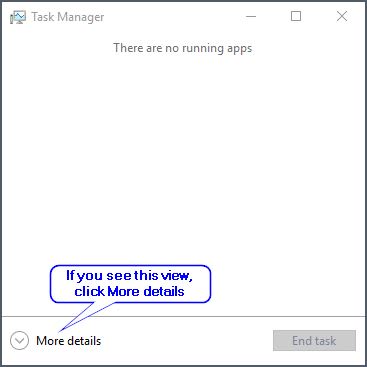
On systems where it has never been used, y'all may detect Job Manager offering this very uninteresting display. You tin click More details to discover the treasure trove of data it is hiding.
The Chore Manager provides quick admission to Processes, Performance, Users, Details, and Services. We'll go through each tab to see what they take to offer and discover what to look for when checking server load.
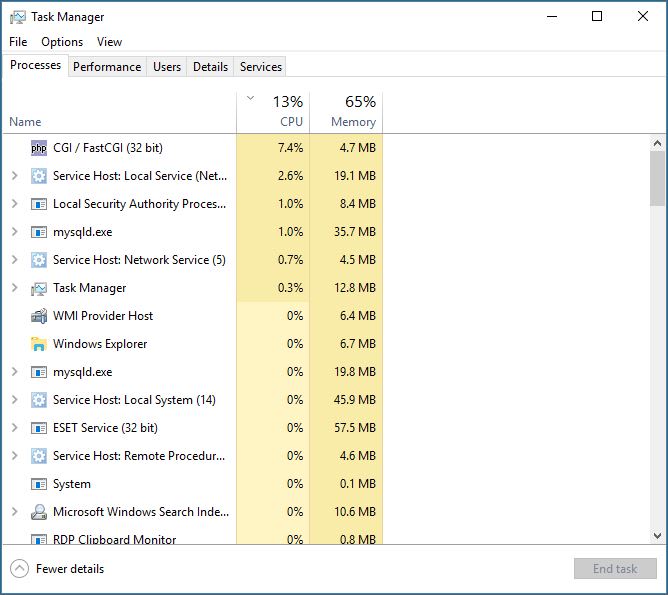
Processes
The Processes tab shows u.s.a. everything that is running in the system and the amount of CPU and retentivity resources it is using. At the top, we tin see the total CPU and retentiveness utilization.
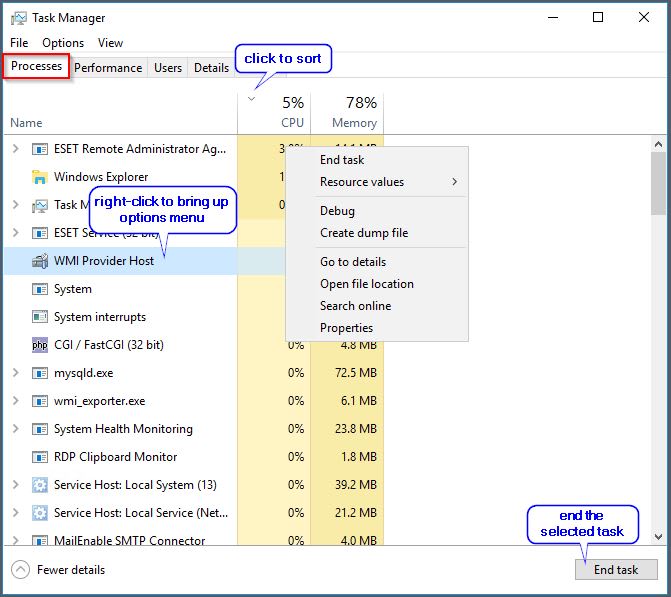
By clicking the CPU or Memory cavalcade headings, we tin sort the processes list by that criteria, and use the sort arrow to determine whether to sort from highest to everyman usage or the opposite. You can click on any private process and end the chore, see resources usage, and more.
Troubleshooting Tip:
If we see a particular awarding is using a high amount of the CPU or memory, it may exist a potential source of performance problems. In the example above, we tin see this server is using 78% of retentivity and just a minimal corporeality of the CPU.
Performance
The performance tab has the most visual display of information and allows us to select from CPU, Memory, and Ethernet views to show activity over a sixty-second period. With this view, we can identify spikes or encounter the trend over time to make up one's mind if a status is temporary or sustained.
CPU Operation
CPU performance information shows u.s. the type of CPU and speed, the number of processes, threads, and handles in use, besides as the number of virtual CPUs, in near cases. We tin besides see how long the arrangement has been up (uptime). This last bit of information can tell us how long the server has been running, confirm if it successfully completed a restart, or if it rebooted unexpectedly due to running out of resources.

Troubleshooting Tip:
In this instance, we see the CPU is at 94%. If this level or higher is sustained over a long catamenia of time, server operation volition be sluggish, and it could affect the stability of the organization. Sustained loftier CPU use is an indicator the system is struggling. Nosotros need to expect at other systems to determine whether information technology is due to applications or insufficient physical retentivity that pushes the system to use virtual memory. Doing this will cause the CPU and disk resources to spike and remain high.
Retention Performance
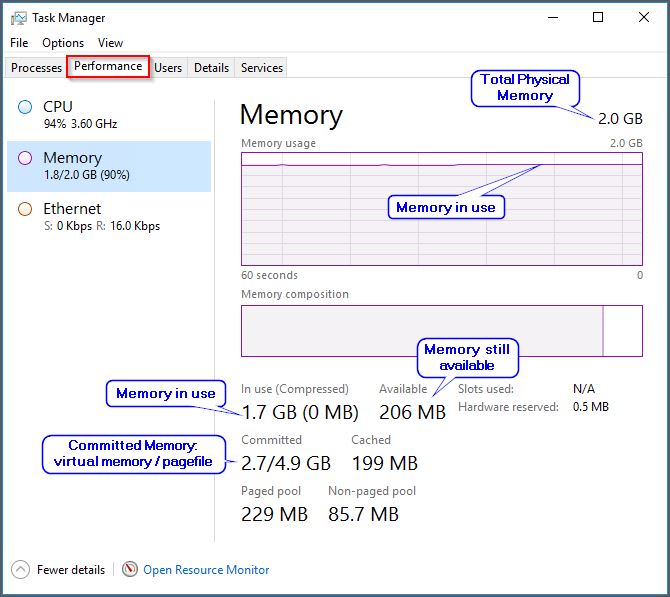
Retention Performance information shows united states of america the total amount of retentiveness in the arrangement as well as what is in apply and bachelor. Committed represents virtual retention and the pagefile (an extension of RAM) on disk. Cached represents retentiveness used by Windows, and the Paged pool represents retention used by Windows that can exist paged out to the pagefile on disk if memory starts running low. Non-paged cannot be paged to the pagefile.
Troubleshooting Tip:
I northward this instance, we see the CPU is at 94%, Memory is at xc%, and we are using virtual memory. When looking at the Committed Memory, nosotros can see that virtual memory is two.seven GB while the pagefile is 4.nine GB. In this example, we have not maxed out the pagefile. If nosotros find the system is continuously running with the CPU and Memory at or to a higher place 90%, information technology is a stiff indicator to add together physical retentivity to the system to reduce the use of virtual memory.
Ethernet Performance
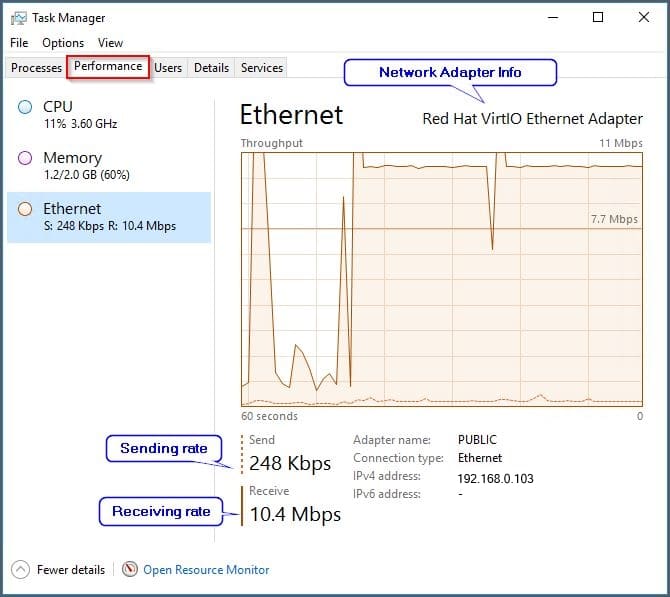
Ethernet performance information shows united states of america the type of network adapter as well every bit the amount of resource information technology is using with a graphed line for both outbound and inbound traffic, equally well every bit numeric values for the data beingness sent. We can also meet the Adapter name, Connection blazon, and the IP address(es) assigned. Right-clicking on the graph will permit us to see network details including network utilization, link speed, state, bytes ship and received, etc. On the Functioning tab, we besides have the option to launch Resource Monitor to see even more detail.
Users
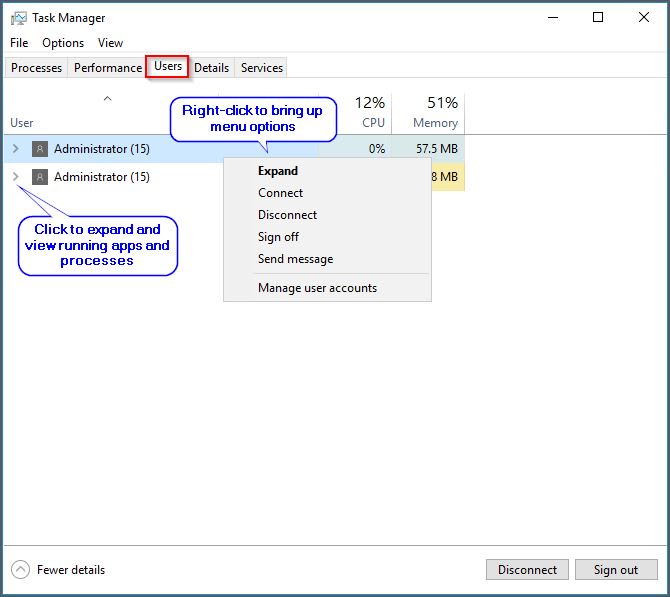
The Users tab shows us a list of all the users continued to the server and how much CPU and retentivity resources the user is utilizing. Nosotros can click on a specific user to disconnect them, send them a bulletin, or accept over their session if we have Administrator rights. In the context of checking for load, we tin make up one's mind if a specific user is consuming too many resources or has asunder from a session, leaving information technology running in memory, and choose whether to log the user out to free up resources.
Details
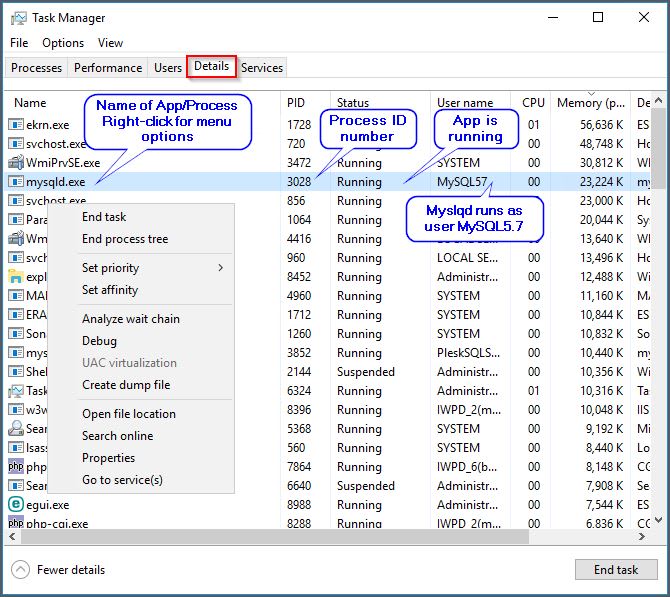
The Details tab shows us a list of all the running programs and processes along with their PID (Process ID) number, whether the program is running or suspended, the username it is running under, the amount of CPU and retentiveness it is using, and a description of the process. You tin click whatsoever of the column names to sort by that column in highest to lowest or the opposite society. The PID number can be very helpful to rail down a specific procedure that is referenced in event logs. Correct-clicking an detail allows usa to choose options including:
- ending a process or process tree
- set a priority for the running procedure
- constitute affinity to a specific processor or all processors
- additional options
Services
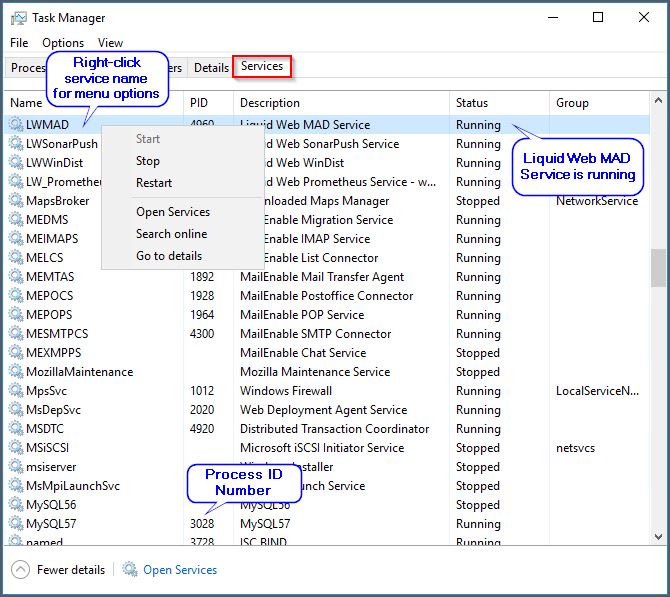
The Services tab shows us a list of service names, their PID (Process ID) numbers, a description of the service, the status as either stopped or running, and the Group the service is running nether. Right-clicking on a service allows united states of america to commencement, terminate, restart, and access additional options. We should exist careful not to alter the status of some services equally they depend on others, and stopping the wrong one could accept unintended consequences on the organisation or devices. To learn more almost a service, we can right-click it and cull Search Online.
How Do I Check My Resource Monitor?
Ways to start Resource Monitor
- Click the Start menu and type resource… then choose Resource Monitor
- Correct-click the Taskbar area and cull Task Manager from the bill of fare, then from Performance tab cull Open Resource Monitor
- Run the command resmon
Let's bring upwards Resources Monitor and take a look at what information technology has to offer. Yous'll notice this has more depth but is very similar to the information available from Chore Manager. For this reason, we'll only cover the overview and a brief description of each tab in this article.
The overview provides us with information on CPU, Retention, Deejay, and Network options and graphs all on ane page with the option to expand or collapse each section. It will also testify current usage of a resource every bit well every bit the highest active time. Clicking private sections provides more detail.
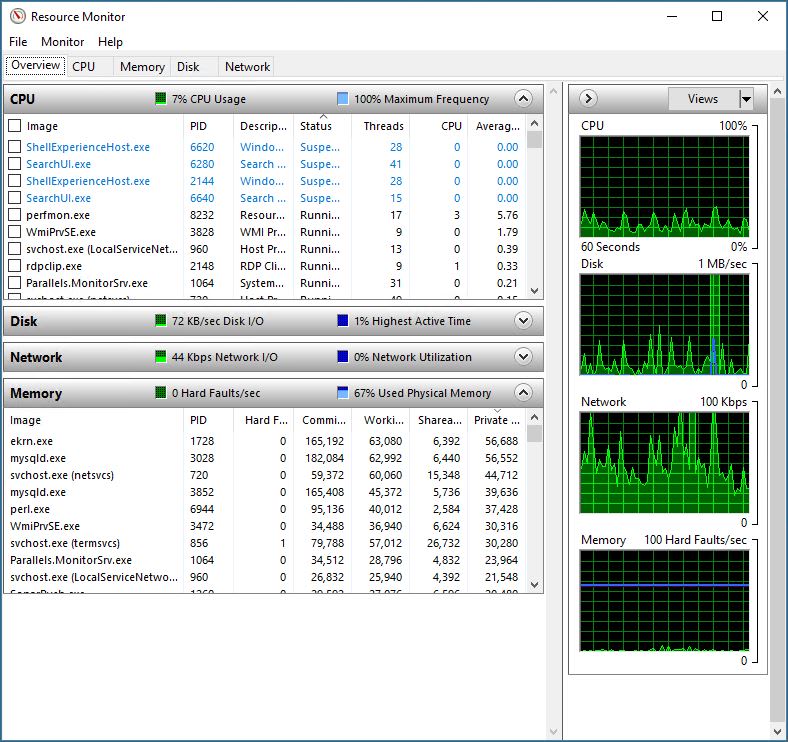
CPU shows processes, services, associated handles, and modules, and volition show individual CPUs and their load in addition to total CPU.
Memory shows processes in addition to a breakdown of the physical memory and graphs to show commit charge which relates to use of the pagefile and the number of difficult faults per second which can exist an indicator of how many times Windows has to admission the bandy file. If your organisation is showing hundreds of hard faults per 2nd, this indicates a demand more than physical memory.
Disk shows the processes in addition to a breakup of how much each job is reading and writing to deejay. The graphs show full disk activity in addition to Queue Length. Disk Queue length indicates how many disk I/O operations are queued upward waiting for their turn to be processed by the disk. If we find that the highest active fourth dimension is above fourscore% and the disk queue length is 2 or higher, it ways processes are waiting, and the performance of the disk is affecting the overall performance of the system. In many cases, this number volition be high due to a system that lacks sufficient physical memory and is constantly paging information to deejay or relying too heavily on virtual retentiveness. It will often be accompanied by a CPU running in a higher place 90% for sustained periods.
Network shows the processes with network activity, in improver to TCP connections and listening ports, and graphs to evidence network transfer and TCP connections. Sustained high network utilization can indicate congestion bug and a need for more capacity.
However having trouble determining what is bogging downward your server? With Liquid Web'due south servers, you can talk to an experienced support tech nighttime or day. Our techs take the expertise needed to aid determine bottlenecks in your system. Switch to Liquid Web today and get the support you've been looking for!
Source: https://www.liquidweb.com/kb/check-server-load-windows-server/
Posted by: collinshandentoich.blogspot.com
0 Response to "How To Check Virtual Memory Usage In Windows 2003 Server"
Post a Comment