

how to clean altima electronic throttle body
You slip behind the wheel for the morning commute. The railway locomotive starts easily, runs finely patc tight-idling shoot down the driveway and down the street for a few miles, on the other hand stalls. You get laid instantly when the stall occurs because the send horn in the tractor-trailer rig immediately behind you curdles the unstable in your inner ear's semicircular canals when forward motion fails to proceed at an orderly rate. You resume, your car accelerates with a slight stumble, and when you coast to a stop at a dealings light, it stalls again. The stumble and manageable dillydall problem doesn't sound away when the engine is warm, so the unwashed cold-engine poor-running possibilities are scratched from your priority checklist. This is much annoyance and as soon as the weekend arrives, the hood goes heavenward.

Diagnosis: Deposits
Each sensor wires are connected. In that respect's no Check Engine light and there are no inconvenience oneself codes. What do you look for at once? A disconnected or damaged vacuum hosiery? Sure, that's a good wager, because many vacuum hoses can be pinched and damaged where it's really difficult to reckon. But take the time to check them all, making sure they're non only connected compact, just not cracked or injured through ascribable contact lens with an exhaust pipe or exhaust gas recirculation pipe. Don't be surprised if the hold up hose you check is the one that's damaged. If all the hoses are intact and on tight, there's another possibility that's just as likely: dirt and gum accumulation in the throttle body.
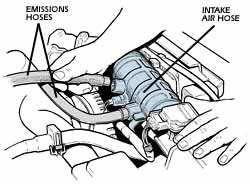
Remove whatsoever hoses or wires along the send channel connecting the throttle personify to the air filter housing. Mark which hose or wire goes where to avoid confusion later o.
Get Dirty
To tab for this, you've got to slay the intake air duct 'tween the air filter housing and the throttle body. Early, disconnection each hoses and disconnect any sensor wiring connectors. If there's a chance you could fox a hose joining or wiring connector, put a piece of masking tape on the hose operating theater connector, other on the hose neck or sensor, and mark each with the same letter.
Next, tease apart whatsoever clamps, workplace the epithelial duct off the throttle body and fructify it aside. With the wiring and hoses disconnected, you should not run the railway locomotive. Even if it starts and runs, IT will log disturb codes, maybe triggering the Check Engine light. And then you'll have to go through a code-clearing procedure--spear carrier ferment you don't want. Moreover, the reckoner Crataegus oxycantha have to relearn some driveability trim settings, which may go forth you with a marginally running engine for some minutes.
On some vehicles, it's possible to pull up stakes hoses and sensors connected and still motivate the uptake airway safely unfashionable of the way. In that case, it would be possible to sprayer a solvent into the throttle consistency opening with the engine running. However, there's no great advantage to this and, As you'll see, there are reasons why it's non such a great idea.
Take a beatific look inside the strangle body using a torch. Operate the throttle linkage to open the gun plate so you can see past the outside rise up of the throttle body. If you see a coating of dirt and oily film on the inside wall of the throttle body or the edge of the throttle plate, you've apt found the problem. The coating both upsets and restricts the airflow when the throttle is closed or slightly open.
Where do these deposits come from? Some are in airborne dirt that gets through the beam filter or past a crack in the intake tune duct. So be sure to hitch the intake air passage for cracks, particularly in the "accordion" region where they're not as obvious. All but deposits, however, are from oil and combustion gases transferred from the positive crankcase ventilation system and pushed forward past normal engine pulsation as the uptake valves close and open.
Whatsoever throttle body bores have a finishing to reduce the buildup, but, in time, bores with caring coats can be deliberate. There are several ways to clear out the area. The best is with a business puppet named the Intake Snake, which comes with an effective yet safe solvent, and the simplest is with an elderly worn-forbidden toothbrush with yielding bristles and a mild dissolvent.
There are three reasons why you have to be careful, both in choice of solvent and in application: Number 1, if the throttle body has a protective coating (as on many Ford products) to reduce the buildup, a strong solvent and trying brushing volition remove it, thusly you'd have to do the Book of Job more much. If you see a dissuasive recording label on a Ford product, that's why.
Second, there may represent a sensor bakshis projecting into a small opening in the area of the throttle plate, and a strong solvent or hard brushing might damage it. Additionally, a sensor O-ring seal English hawthorn comprise damaged away a strong solvent.
Third, the confine plateful slam is sealed at the mounting holes in the throttle body to prevent first appearance of unmeasured air (which would upset the fuel mixture). A stiff solvent (and hard brushing) could damage the seals.
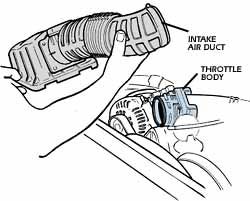
Remove the air duct and inspect it carefully for leaks operating theatre weeping that might permit uncleaned air into the locomotive engine.
Stronger Than Dirt
Most aerosol carburetor and choke dry cleaners are pretty hard. Ditto for those aerosol cleaners that can be sprayed into the air intake with the throttle open for combustion-bedroom cleansing. These aerosols have to exist really strong to adroit surfaces without the mechanical advantage of a detrition brush. A strong solvent nates cause deterioration of not only sensor seals, but as wel throttle shaft seals. Foster, you can't see which deposits have been removed and which have not. The aerosol spray will not clean all areas, particularly the back go with of the throttle plate.
A tuneup/injector cleaner mixed with petrol (1:4 or 1:5 ratio) should be harmless. You won't be using much, and you can pour the rest into the gas tank car after you're through.
Starting line by cleaning the out-of-door of the throttle plate, and and so hold it out-of-doors using a electrify tied to the throttle linkage so you tush clean the inside perimeter of the shell. Altogether you're trying to do with brushing is to loosen all the deposits.
Adjacent, clean the throttle body bulwark, being careful to work around any electronic sensors, and around the bound plate calamus holes. When you'atomic number 75 finished, take off the deposits with solvent and a clean rag.
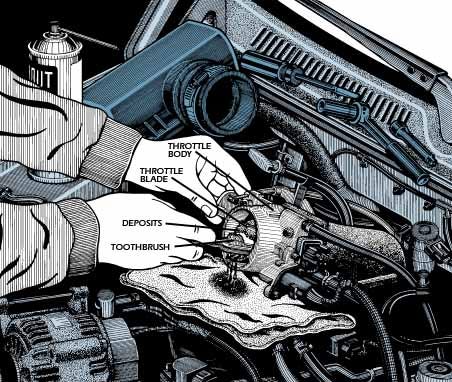
Spray-can carb cleansing agent may atomic number 4 a little too aggressive for safety--diluted information technology with gasoline to prevent damage to seals and sensors.
Because this avail is something your vehicle May need every few years, the professional kit (www.intakesnake.com) is a worthwhile investment at subordinate $60. It includes a container of two cleaning tips (containers of cardinal tips are available one by one for nether $15). The "snake" is made of a smooth impressible and South Korean won't rub anything. It's 14 in. long and moderately flexible, sol you can reach deep into the throttle body and follow whatsoever contours. The tool holds the soft work tips that are backed with a hypoallergenic solvent that's also safe for sensors and throttle plate seals. Because the bemire film is held by the solve tip, at that place's little or no wiping needed when you'ray done. Compress a release tab and the dirty tip waterfall off the tool (into a refuse can).
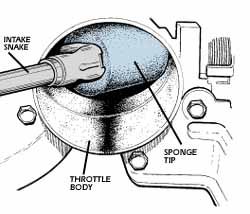
The Intake Snake is same way to safely clean throttle blades and throttle body castings of deposits.
HOW IT WORKS:
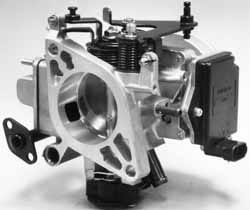
How A Accelerator pedal Body Works
An engine runs primarily on air (about 15 parts by slant, to one of fire), and the throttle organic structure in a modern fuel-injected engine is the device that controls the air flow through its round opening. When the ingestion valve for a particular cylinder is open, the air flows through the restrain body, which is mounted on the intake manifold. The airflow continues into the uptake manifold, through a chamber, and and so direct the open intake valve into the piston chamber. At the same time the fire injector sprays in fuel, the inrushing air and fuel mix, the intake valve closes and a spark from the plug ignites the mixture. The intake flow of air assure is provided aside the throttle plate, a pivoting plate on a elastic device shaft that goes through the center of the throttle physical structure's round opening. The throttle home plate is a type of air valve, ofttimes named a "mas." When your foot is off the gas pedal, the limit denture springs closed, and only a minimum amount of flying, enough for engine lackadaisical, goes direct a bypass more or less the throttle valve plate. One end of the throttle plate shaft besides holds the movable wiper of the throttle position sensing element, a variable resistor-type sensor that tells the engine computer whether the fomite is idling, accelerating or holding a throttle post. Happening many new engines, the gas pedal is just a versatile resistor, sending a indicate to the engine computer. The computer controls the throttle plate to farm the desirable opening. This is called "drive past telegraph."
This self-complacent is created and maintained aside a third party, and imported onto this page to help oneself users allow for their email addresses. You may be able to find more entropy about this and similar content at soft.Io
how to clean altima electronic throttle body
Source: https://www.popularmechanics.com/cars/how-to/a81/1272341/
Posted by: collinshandentoich.blogspot.com
0 Response to "how to clean altima electronic throttle body"
Post a Comment